It is safe to say that there are not many rocks large enough to hide from the current wave of excitement surrounding Generative AI. ChatGPT has taken the world by storm and everyone is looking for a way to leverage the ability of AI to create novel and interesting outputs. Is the value limited to content creation and customer support? Or are we yet to discover the real opportunity presented by language, visual and audio generation models?
When it comes to retail opportunities for applying generative AI, our minds naturally wander to customer support scenarios. We have long wrestled with making these types of automated interactions more human-like, and this is certainly an area of opportunity – however it is worth expanding the train of thought a little.
GenAI + DIY
I like to do a bit of DIY, and one of the most frustrating parts of the experience is trying to find the products I need. Not because there are not good hardware retailers in the market - but because as a non-expert, my understanding of the facets of the products is not necessarily consistent with the way they are described by experts, or the companies that produce them. This has always been a difficult gap to bridge – which level of knowledge do you cater for? Rather than having to pick one or the other, using a rich semantic search alongside the existing search facets is an effective way to bridge my knowledge gap, while maintaining the relationship with the trade experts that buy exactly the same product in a more nuanced way. I can ask “What screws should I use to build a wooden tree support”, while they can head directly to the tightly categorised outdoor screw type they need.
GenAI + fashion
Alongside my DIY, I am also a sneaker collector. I have enough Jordans that my problem has become finding the right outfits to wear them with. Styling Jordan 4s for work is a tough task, but with the help of a comprehensive Pinterest board I have managed to borrow enough ideas from others to be able to style for work, and dinner with friends. Unfortunately none of this helps when I am shopping online. The disconnect between my style catalogue and the one provided by the retailer means the heavy lifting is left to me. By bringing together image description generation and semantic searching it is possible to ingest the images I have pinned, describe them, and use that with a search to effectively produce a catalogue that is hyper-personalised to my taste and style.
None of these capabilities are without risk. In both of these scenarios we have effectively managed the risk by using an existing product catalogue as a filter on the possible output. In early experiments we have commonly used this kind of approach, or put a human between the AI output and the end consumer to ensure that the impact of any error is minimal.
There are great studies showing that there is quite a lot of productivity uplift to be had using the output of a generative model as a support tool to human agents. Both of these approaches mean you can start to explore today while you build your position towards the risks of hallucination, bias, certainty and explainability.
Generative AI has a wide range of capabilities – descriptive content generation, rich semantic searching, context sensitive categorisation, assisted design of products or services, and hyper-personalisation, that can be used in stand alone fashion or as combinations to achieve rich interactive digital capability that fits into existing web or mobile applications. To make the most of the opportunity, we need to challenge our bias towards pure chat interaction and consider system to system, multimedia and combinatorial applications of the key capabilities.
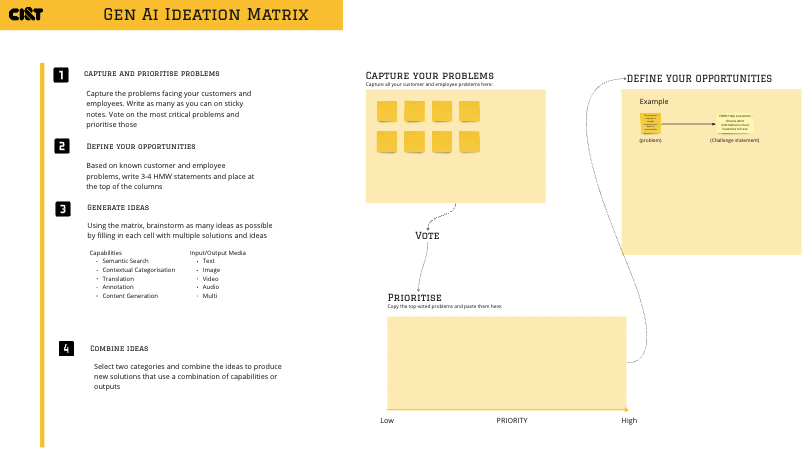
In our work with clients, we've found that a great place to begin exploring the opportunities for their business is with a GenAI Ideation Matrix [PDF], accessible via the link and pictured below.
If you would like help working out what is feasible in the opportunities you see, get in touch.