I first heard about the Axial Revolution thanks to John Vervaeke and his YouTube series "Awakening from the Meaning Crisis."
The term originated with the German psychiatrist and philosopher Karl Jaspers, who noted that during the period of antiquity, roughly 800 B.C. to 200 B.C., there was a shift—or a turn, as if on an axis—away from predominantly local concerns and towards transcendence.
This inquiry sought a moral structure to explain how one should live to achieve happiness and remain in balance with the wishes of the gods. The Axial Age was not confined to the West; it spanned the globe from the Middle East, through India, and into China. It featured figures such as Plato, Confucius, Buddha, and Jeremiah, whose ideas profoundly influenced the future of religion and philosophy. The fact that these thinkers lived across the globe and emerged at nearly the same historical period suggests that human moral evolution had reached the same point simultaneously, perhaps under the influence of common factors.
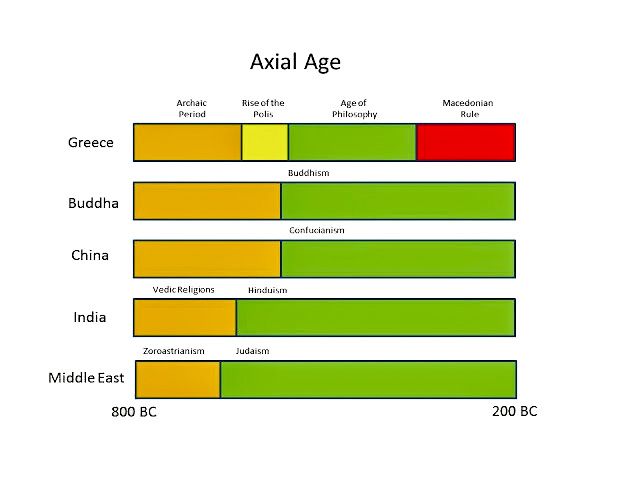 Image source: The Daily Journalist
The AI-Driven Axial Age
Just like the Axial Revolution, the AI-driven axial age has individuals influencing the future of the relationship between humanity and technology as follows:
1. Alan Turing
Key Dates: Turing Test: Introduced in 1950 in his paper "Computing Machinery and Intelligence".
2. John McCarthy
Key Dates: Term "Artificial Intelligence": Coined in 1955.Dartmouth Conference: Organised in 1956, it is considered the founding event of AI as a field.
3. Marvin Minsky
Key Dates: Co-authored "Perception" in 1966 and "The Society of Mind" in 1986, contributing significantly to AI theories.
4. Geoffrey Hinton
Key Dates: Backpropagation Algorithm: Published in 1986. Deep Learning Papers: Key papers published in the mid-2000s, notably in 2006.
5. Yoshua Bengio
Key Dates: Deep Learning Research: Significant contributions in the late 1990s and early 2000s, with key papers in 2006 alongside Hinton and others.
6. Ian Goodfellow
Key Dates: Generative Adversarial Networks (GANs): Introduced in 2014 in his paper "Generative Adversarial Nets".
7. Dario Amodei
Key Dates: OpenAI: Joined OpenAI in 2016; co-authored papers on AI safety and alignment.
8. OpenAI Team
Key Dates: GPT-3 Release: Announced in June 2020.DALL-E Release: Announced in January 2021.
9. Andrew Ng
Key Dates: Google Brain: Co-founded in 2011.MOOC on AI: Launched in 2012, popularising AI education.
10. Fei-Fei Li
Key Dates: ImageNet Project Launch: Started in 2009, significantly impacting computer vision and AI research.
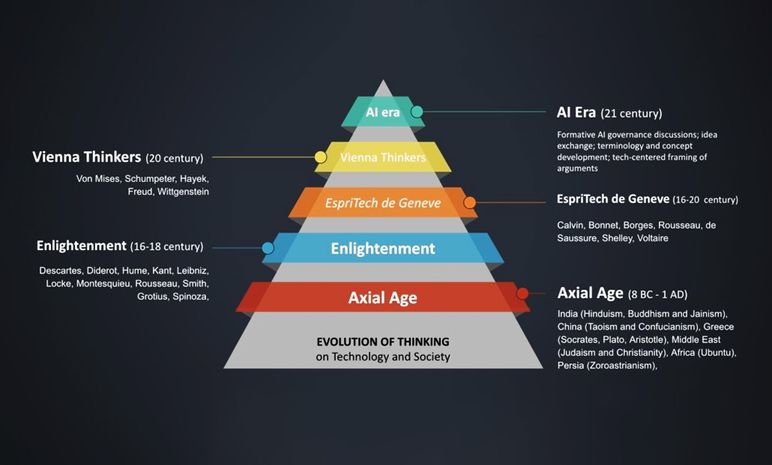
Image source: Diplomacy
Relationship Between the Axial Revolution and Generative AI
Transformational Impact
Generative AI represents a significant shift in how we approach creativity, problem-solving, and productivity. This aligns with the notion of the Axial Revolution as it transforms traditional workflows and methodologies.
Enabling Innovation
Generative AI fosters innovation by providing tools that enhance creative processes. This shift can lead to new ideas, products, and services, representing a modern-day axial shift in various industries.
Changing Paradigms
The rise of generative AI challenges existing paradigms regarding authorship, creativity, and intellectual property. This shift can be seen as part of a broader axial change in how society interacts with technology and creativity.
Interdisciplinary Collaboration
Generative AI encourages collaboration across disciplines, breaking down silos in industries such as art, science and technology. This collaborative approach is reminiscent of the widespread intellectual exchange characteristic of the Axial Age.
The Future of Work
As generative AI becomes more integrated into various fields, it may redefine roles and responsibilities, much like previous axial revolutions have done in history. This leads to discussions about the future of work and the skills needed in a rapidly evolving landscape.
Conclusion: The Relationship between Axial Revolution and Generative AI
The relationship between the Axial Revolution and generative AI highlights how transformative technologies can lead to significant shifts in thinking and practices across various domains. Generative AI acts as a catalyst for innovation, creativity and new paradigms, mirroring the profound changes associated with historical axial revolutions.
And while this is happening, we are witnessing the emergence of the mindfulness revolution, Westernised Buddhism and the revival of Hellenistic-era philosophies such as Stoicism. This is no coincidence.
References
https://www.diplomacy.edu/blog/on-the-threshold-of-the-ai-axial-age/
https://thedailyjournalist.com/the-historian/the-axial-age-man-becomes-a-philosopher/
https://medium.com/@Matthew_Lewin/awakening-from-the-meaning-crisis-41de74281ee4